
AIQ
The multi-dimensional orchestration engine for enterprise AI networks
Eliminates coordination chaos, token bloat and structural risk in autonomous agent swarms.
- Up to 40%lower cloud compute fees
- <30 cyclesto resolve routing logjams
- 20 cyclesto quarantine rogue nodes

What is AIQ?
AIQ is an orchestration engine for large enterprise AI agent networks that maps agent nodes across virtual, multi-dimensional hyper-spheres and routes work with localized mathematical gradients instead of flat communication. It is designed to eliminate coordination chaos, token bloat and structural risk in autonomous agent swarms, and runs as pure software on standard cloud infrastructure.
- Product
- AIQ
- Category
- AI orchestration engine
- Built by
- Xplora Kodo Company (XKCo), Kathmandu
- Updated
Enterprise agent swarms are suffering from coordination collapse
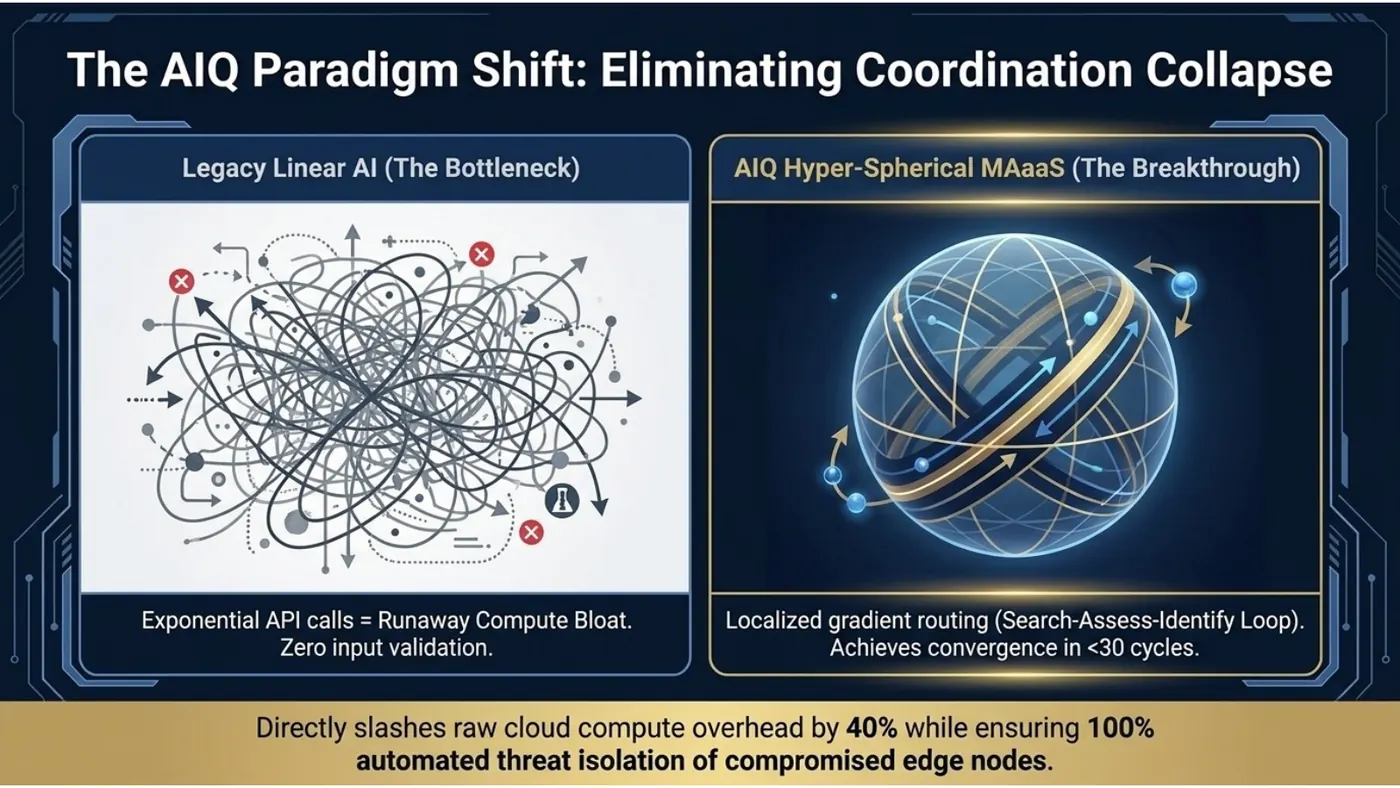
The scale-cost paradox: as enterprise networks expand to thousands of autonomous agents, legacy "flat" communication frameworks add exponential coordination overhead and turn compute into a runaway cost centre.
-
The token bloat trap
Flat, unoptimised agent routing paths drive skyrocketing cloud API compute fees.
-
The latency logjam
Linear communication queues cause systemic lag in real-time data flows.
-
The vulnerability exposure
Without hardware-attested edge isolation, a single rogue node can corrupt global memory.

A hyper-spherical orchestration layer
AIQ bypasses flat architectures by mapping autonomous agent nodes across virtual, multi-dimensional hyper-spheres, streamlining routing topologies with localized mathematical gradients.
-
Hyper-spherical routing (n-D space)
Optimises data pathways using localized gradients, resolving network logjams in under 30 cycles.
-
Predictable compute protection
Compresses systemic data bloat to cut raw enterprise cloud compute fees by up to 40%.
-
Automated threat isolation
Triggers immediate algorithmic decay to quarantine compromised or rogue nodes within 20 cycles.
Three pure-software engine primitives
AIQ's technical moat is built from three primitives that model, route and police every node in the network.
-
Model every asset (the Asset Base Class, AM)
Every computational resource and LLM endpoint is modelled as an observable state node, divided cleanly into tangible and intangible assets.
-
Search, assess, identify (the SAI loop)
A localized gradient engine instantly calculates alternate routing pathways that return the agent network to steady-state stability.
-
Balance the load (Net-Benefit gradient)
Automatic mathematical drag on heavily congested nodes naturally load-balances tasks across the cheapest paths.
-
Police the network (Counter-Trade Asset Ledger)
A hardware-attested execution protocol monitors node performance; any asset broadcasting false data has its weight slashed to zero.
Built for thousands of agents
-
Hyper-spherical routing
Maps agents across multi-dimensional hyper-spheres — for example 500+ agents across a 10-D hyper-sphere in the FinTech model.
-
Compute cost guardrail
The Net-Benefit engine keeps work on the cheapest paths to stop runaway cloud fees.
-
Rogue-node quarantine
Compromised nodes are isolated automatically within 20 cycles.
-
Hardware-agnostic on day one
The core software runs on standard AWS and GCP cloud environments.
-
Silicon-ready roadmap
A Spherical Chip and Asset Processing Units (APUs) for on-device AIQ acceleration, planned as a later, revenue-funded stage.
Software first, decoupled from hardware risk
AIQ works on day one as a hardware-agnostic software platform; custom silicon is a later, revenue-funded multiplier.
Stage 1 — Software platform
Python/C++ engine refinement and foundational patent claims, anchored by enterprise pilots.
Stage 2 — Multi-tenant cloud scaling
Launch of a state-based Spherical Language communication protocol across distributed networks.
Stage 3 — Silicon acceleration
Tape-out-ready GDSII design files for physical RTL chip synthesis.
Bottom-line recovery across high-value verticals
Modelled impact from the AIQ deck's empirical performance analysis.
-
FinTech & liquidity swarms
Maps 500+ agents across a 10-D hyper-sphere, balances transaction paths and isolates rogue pricing oracles.
-
Precision agro-industry
Coordinates IoT telemetry; the Net-Benefit engine reroutes logistics around global transport bottlenecks.
-
Clinical biotech & pharma
Monitors trial telemetry and data logging; the ledger quarantines unauthorised data manipulation.
A multibillion-dollar shift in AI orchestration
- $300B TAM — AI decisioning, multi-agent layers and graph-based enterprise computing
- $40B SAM — enterprise constraint-optimisation and orchestration software
- $500M SOM — Year-5 target across fintech, logistics and clinical trials
Market sizing (USD) as presented in the AIQ deck (Sept 2026).
Who builds AIQ
Investor data-room access is restricted to qualified institutional venture partners.
-
R&D Department, XploraKodo Company
Core IP architect
Developer of the AIQ paradigm and author of the hyper-spherical mathematical modelling framework.
-
Binaya Rawal
CEO, XploraKodo Company — Strategic Business Dev. Partner
Capital allocation models, enterprise client acquisition and institutional venture capital relations.
Contact: [email protected]
What is AIQ?
AIQ is a multi-dimensional orchestration engine for enterprise AI networks. It maps autonomous agents onto virtual hyper-spheres and uses localized mathematical gradients to route work, control cost and isolate compromised agents.
How is AIQ different from flat multi-agent frameworks?
Flat frameworks route messages linearly, so coordination overhead grows exponentially with the number of agents. AIQ's Search-Assess-Identify loop recalculates routes locally, which the deck states resolves logjams in under 30 cycles and cuts cloud compute fees by up to 40%.
Does AIQ require special hardware?
No. AIQ is hardware-agnostic on day one and runs on standard AWS and GCP cloud environments. Custom silicon (the Spherical Chip and APUs) is planned as a later stage.
How does AIQ deal with rogue or compromised agents?
The Counter-Trade Asset Ledger continuously monitors node performance with hardware-attested edge gating. Any asset broadcasting false data has its operational weight slashed to zero, and compromised nodes are quarantined within 20 cycles.
Which industries is AIQ aimed at?
High-yield niches with large agent networks: fintech and liquidity swarms, precision agro-industry and clinical biotech and pharma trials.
How does AIQ relate to ORCHESTRA and Swarm Factory?
AIQ is the orchestration layer of XploraKōdo's multi-agent stack: ORCHESTRA and Swarm Factory deploy agent workforces, and AIQ keeps very large networks of those agents efficient and secure.
Ready to see AIQ in your organisation?
Tell us about your team and goals — the XKCo product team will follow up with a tailored walkthrough.
Explore the rest of the suite
-
 MAaaS
ORCHESTRA
Enterprise Multi-Agent as a Service (MAaaS)
Learn more
MAaaS
ORCHESTRA
Enterprise Multi-Agent as a Service (MAaaS)
Learn more
-
 Digital Twin
Swarm Factory
Company Cloning: the Enterprise Digital Twin
Learn more
Digital Twin
Swarm Factory
Company Cloning: the Enterprise Digital Twin
Learn more
-
 Voice AI
Jyotisha AI
The AI Jyotisha companion for lifetime
Learn more
Voice AI
Jyotisha AI
The AI Jyotisha companion for lifetime
Learn more
-
 Infrastructure
Global AI Infrastructure
The Workforce Infrastructure Gateway — Nepal to the world
Learn more
Infrastructure
Global AI Infrastructure
The Workforce Infrastructure Gateway — Nepal to the world
Learn more