
Swarm Factory
Company Cloning: the Enterprise Digital Twin
Turns your org charts, SOPs, ChatOps history and codebases into a 24/7 AI digital twin of your company. Xplora Kodo × Swarm Agency.
- 24/7digital twin of your operations
- 90%less LLM token overhead (SCMS)
- Level-4semantic firewall
What is Swarm Factory?
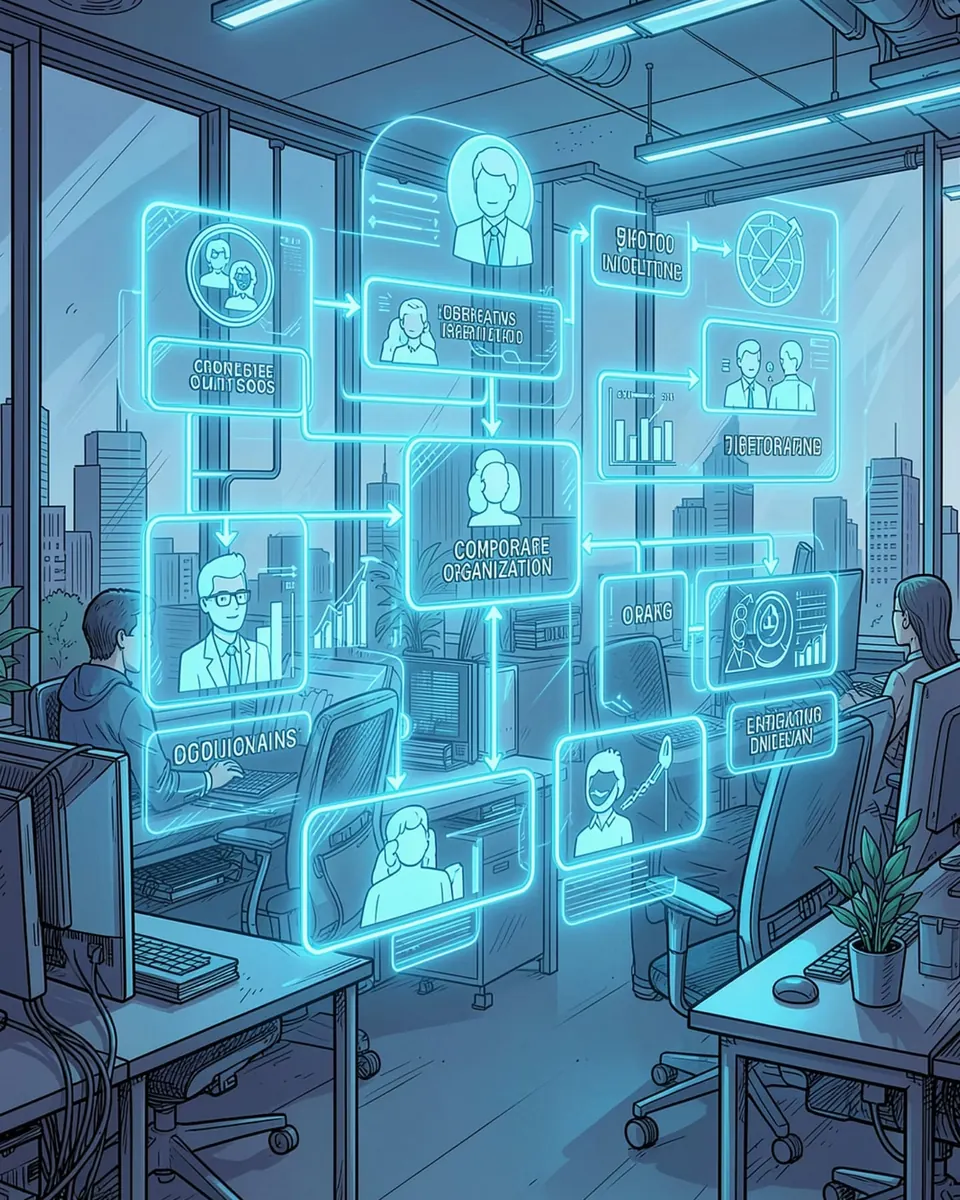
Swarm Factory is a Multi-Agent as a Service platform from Xplora Kodo Company and Swarm Agency that "clones" a company: it ingests org charts, SOPs, ChatOps history, codebase patterns and database schemas, then instantiates matching AI agents that run as a 24/7 digital twin of the organisation. Every agent works under a cryptographic E-Contract, and high-risk actions wait for explicit human approval.
- Product
- Swarm Factory — Company Cloning
- Category
- Enterprise digital twin (MAaaS)
- Built by
- Xplora Kodo Company (XKCo), Kathmandu
- Updated
Fragmented AI tools forget, leak and act unchecked
Most enterprises run isolated generative-AI point tools. They are stateless, expensive and unsafe when left running without oversight.
-
Stateless
Chats are forgotten, so institutional knowledge never compounds — and walks out the door with staff turnover.
-
Expensive
Dumping whole context windows into every call inflates token costs.
-
Unchecked
AI without guardrails poses real liabilities: unapproved emails, erroneous financial transactions and data leaks.
"Company Cloning" — your Enterprise Digital Twin
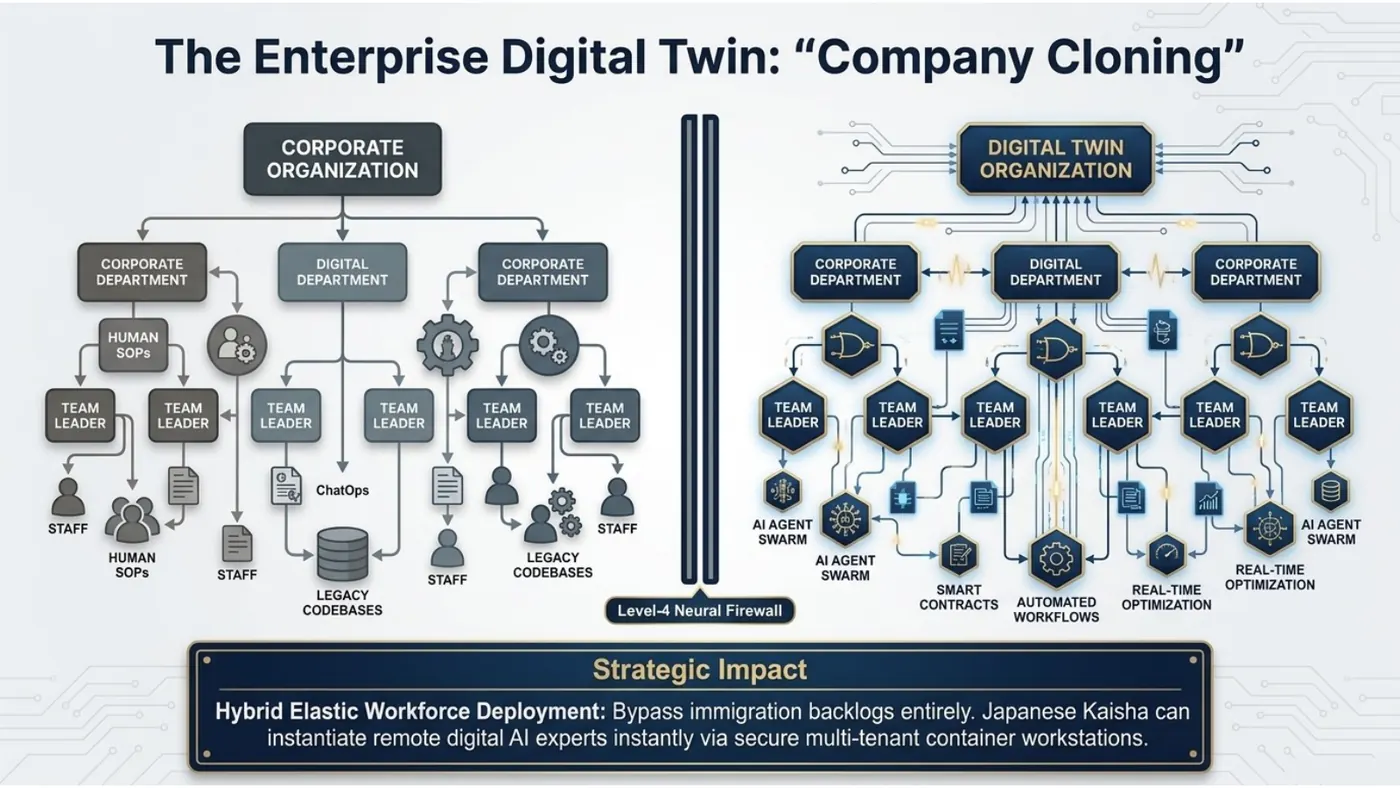
Swarm Factory moves you from fragmented AI utilities to an integrated, autonomous and self-governed organisational ecosystem.
-
Ingest the whole context
Organisational charts, SOPs, historical ChatOps data, codebase patterns and database schemas.
-
Replicate it digitally
The Swarm Factory translates those sources into a virtual, real-time map of your operations.
-
Run the digital twin swarm
The map dynamically instantiates matching AI agents that act as a 24/7 digital twin of the company.
-
Preserve institutional memory
Knowledge stays secure, operational and executable — even during human turnover.
From org chart to governed agent workforce
-
Ingest & map
Your organisational context is ingested and schema-mapped into a real-time map of how the company actually works.
-
Fabricate agents with cognitive profiles
The fabrication engine (run_swarm_factory.py) generates agents with explicit IQ baselines, role-specific tool suites and role-based isolation.
-
Bind every agent to an E-Contract
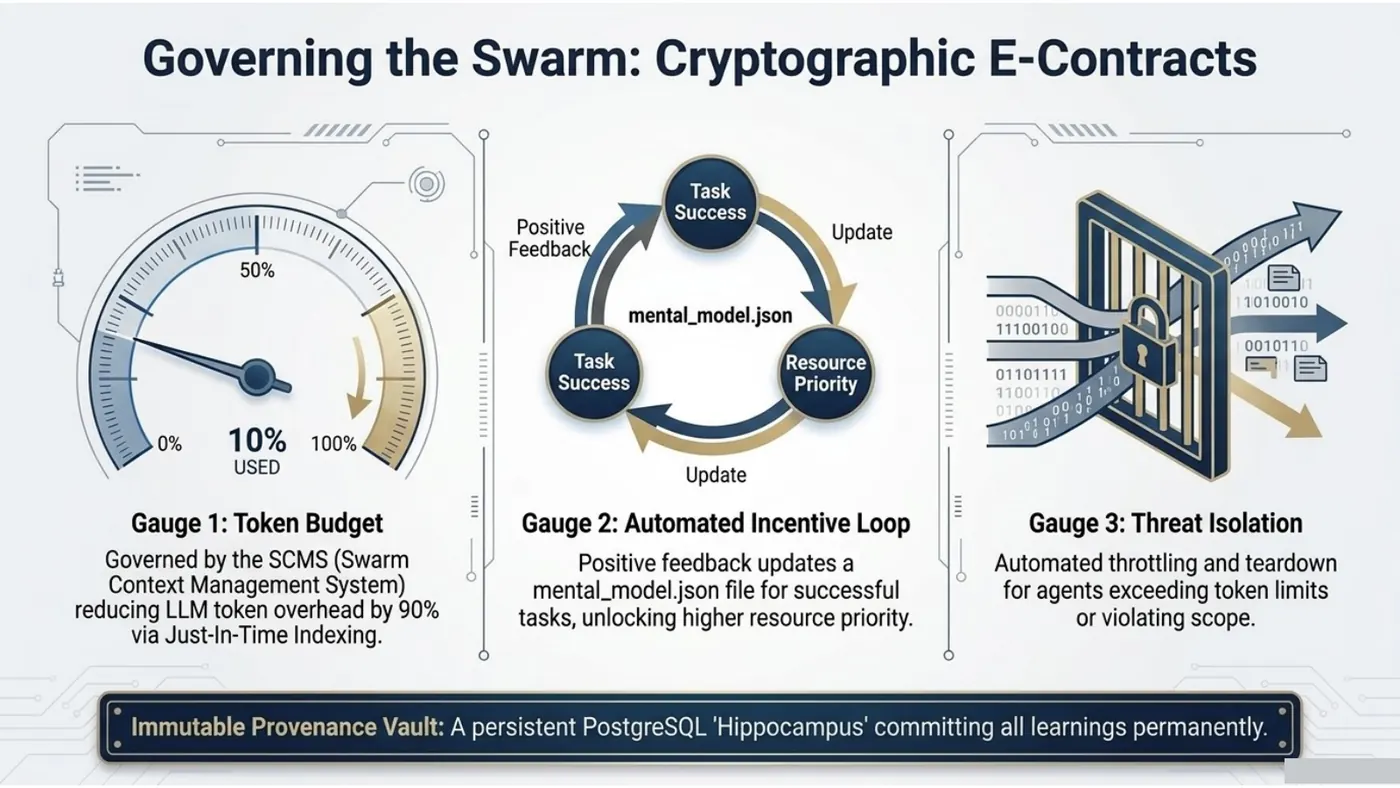
Cryptographic E-Contracts hardcode token budgets and deliverables; good work earns resource priority, repeated failure triggers throttling or re-fabrication.
-
Gate high-risk actions
Anything tagged [RISK_LEVEL: HIGH] — board emails, code deployments, financial execution — is locked until a manager supplies a cryptographic human_approval_token.
-
Learn permanently
Learnings are committed to the Immutable Provenance Vault so the swarm builds collective intelligence over time.
Enterprise-ready middleware under the hood
-
Cognitive profiles
No flat, generic prompting: lightweight models for fast triage, heavy reasoning models for deep audits, and custom tools per role (e.g. Agent_NetSec, Agent_DBA).
-
Cryptographic E-Contracts
Token limits, deliverables, rewards and penalties enforced algorithmically for economic predictability.
-
Level-4 "Neural Firewall"
Agent_NetSec intercepts all inter-agent traffic to redact PII and block cross-domain context bypasses.
-
Secure Token Economy (SCMS)
The Swarm Context Management System cuts LLM token overhead by 90% with Just-In-Time Indexing and cryptographic artifact hashes.
-
Real-time business intelligence
Agents use Model Context Protocol (MCP) clients to scan markets and competitors, and Agent_Executive_Liaison drafts "Strategic Pivot Proposals" for the board.
-
Immutable Provenance Vault
A persistent PostgreSQL "Hippocampus" that commits learnings permanently.
Production architecture
Backed by microservices, a central Streamlit administration panel (dashboard.py) and a high-throughput FastAPI server (api_server.py). Production swarm factories deploy directly inside secure client virtual private clouds (VPCs).
Agent fabrication
run_swarm_factory.py generates, runs and monitors your custom digital workforce.
Governance
E-Contracts, a mental_model.json incentive loop and automated teardown for agents that exceed limits or violate scope.
Memory
Immutable Provenance Vault on PostgreSQL plus a vector database for research.
A force multiplier, not a replacement
The digital twin swarm works alongside your people as their most advanced support layer.
-
Continuous process optimisation
Agents scan internal work logs, find friction points and compliance bottlenecks, and suggest streamlined SOP updates.
-
Interactive human coaching
Real-time training materials, step-by-step guides and Socratic mentoring for junior staff, generated from your own data.
-
Board-level market intelligence
Autonomous scans of market verticals, competitors and pricing indices, turned into proposals for the human board.
-
Hybrid elastic workforce
Japanese companies can instantiate remote digital AI experts through secure multi-tenant container workstations, bypassing immigration backlogs.

Legacy generative AI vs. the MAaaS platform
| Evaluation axis | Legacy generative AI | Swarm Factory MAaaS |
|---|---|---|
| State & memory | Stateless (chats are forgotten) | Persistent PostgreSQL "Vault" |
| Data cost | Context-window dumping (expensive) | JIT token optimisation (SCMS) |
| Security | Zero input validation | Level-4 security & semantic firewalls |
| Performance | Best-effort output | E-Contract budgets & reward/penalty loops |
| Business value | Isolated point tools | Digital-twin "Company Clone" |
Why it pays off
- 90% reduction in LLM token overhead via SCMS
- 24/7 digital twin operation
- Human-gated every [RISK_LEVEL: HIGH] action waits for approval
Figures as stated in the Swarm Factory deck (Sept 2026).
Three ways to engage
-
Company Cloning & setup
Upfront fee
High-touch organisational ingestion, schema mapping and initial agent fabrication.
-
MAaaS platform subscription
Tiered licence
Access to the core dashboard, API servers and system SRE agents.
-
Consumption & commission
Usage-based
A percentage surcharge on agent-managed token budgets under contract, scaling with the twin's throughput.
Xplora Kodo Company × Swarm Agency
A strategic alliance blending advanced multi-agent system design with Xplora Kodo's enterprise networks, starting with corporate pilots in the US and Japan tech and audit corridors.
-
Step 1
Establish the joint venture
Formalise the go-to-market structure between the development teams and Xplora Kodo.
-
Step 2
Targeted executive showings
Private platform demonstrations for high-tier business targets.
-
Step 3
Scale the swarm
Deploy production-grade Swarm Factories inside secure client VPCs.
Who is behind Swarm Factory
-
Binaya Rawal
CEO & Founder, Xplora Kodo Company
Cross-border enterprise networks and proof-of-concept partnerships.
-
Swarm Agency
Strategic alliance partner
Advanced multi-agent system design and the Swarm Factory engine.
Contact: [email protected]
What is "company cloning"?
Company cloning creates an Enterprise Digital Twin: Swarm Factory ingests your org charts, SOPs, ChatOps history, codebase patterns and database schemas, maps them into a real-time model of your operations and instantiates matching AI agents that run 24/7.
Does Swarm Factory replace employees?
No. The digital twin works alongside your people as a force multiplier — it takes over low-leverage repetitive work, suggests SOP improvements and coaches junior staff so humans can act as high-level orchestrators.
How are risky AI actions controlled?
Any action tagged [RISK_LEVEL: HIGH] — external board emails, code deployments, financial execution — is locked until a human manager supplies a cryptographic human_approval_token. A Level-4 semantic firewall (Agent_NetSec) also redacts PII from inter-agent traffic.
What is an E-Contract?
Every fabricated agent operates under a cryptographic E-Contract that fixes its token budget and deliverables. Efficient work earns higher resource priority; repeated failures, overspending or boundary violations trigger throttling or automated teardown and re-fabrication.
Where does Swarm Factory run?
Production-grade Swarm Factories are deployed directly inside secure client virtual private clouds (VPCs), backed by a FastAPI server, a Streamlit admin dashboard and a PostgreSQL Provenance Vault.
Who builds Swarm Factory?
It is delivered through a strategic alliance between Xplora Kodo Company (XKCo) and Swarm Agency.
Ready to see Swarm Factory in your organisation?
Tell us about your team and goals — the XKCo product team will follow up with a tailored walkthrough.
Explore the rest of the suite
-
 MAaaS
ORCHESTRA
Enterprise Multi-Agent as a Service (MAaaS)
Learn more
MAaaS
ORCHESTRA
Enterprise Multi-Agent as a Service (MAaaS)
Learn more
-
 Orchestration
AIQ
The multi-dimensional orchestration engine for enterprise AI networks
Learn more
Orchestration
AIQ
The multi-dimensional orchestration engine for enterprise AI networks
Learn more
-
 Voice AI
Jyotisha AI
The AI Jyotisha companion for lifetime
Learn more
Voice AI
Jyotisha AI
The AI Jyotisha companion for lifetime
Learn more
-
 Infrastructure
Global AI Infrastructure
The Workforce Infrastructure Gateway — Nepal to the world
Learn more
Infrastructure
Global AI Infrastructure
The Workforce Infrastructure Gateway — Nepal to the world
Learn more